
You want the lowest price on liraglutide that won’t get you hurt. Fair goal. Here’s how to get there without wasting an afternoon on forums and sketchy storefronts.
Skip to the number if you want it: a physician-supervised GLP-1 program running roughly $199 to $449 a month is the real price range for legitimate liraglutide. Anything dramatically below that isn’t a bargain, it’s an unlabeled vial and a research-use-only disclaimer designed to keep the seller out of court. That’s not cheap. That’s a wager you’re paying to lose.
One thing before the list: liraglutide is a prescription drug. The branded pens (Saxenda, Victoza) are FDA-approved. Compounded liraglutide from a licensed pharmacy is not the same product as the approved pen, and a real clinician needs your history before any of this makes sense for you. This article names providers and reasons. It doesn’t sell anything and there’s no checkout link here.
The four things that have to be true before price matters
Run any provider through these before you look at the number.
1. The price is the real, ongoing price. Not a teaser rate that jumps in month two. What does the program cost after the first prescription refills, plainly stated?
2. Someone is actually managing your dose. Liraglutide is titrated up over weeks. Climb too fast and the nausea is bad enough that people quit before it works [1]. If nobody’s watching that climb, you’re not getting a discount, you’re getting an unfinished product.
3. You can name where it comes from. Branded Saxenda or Victoza from a licensed pharmacy. Or compounded liraglutide from a licensed compounding pharmacy. If the answer is “research use only” and a shrug, stop reading their pricing page.
4. No costs hiding downstream. Labs, consult fees, shipping, dose-change fees. Add them up. The real cheap option has a total close to its headline number.
Notice what’s not on this list: lowest price as its own virtue. With this drug the actual lowest price belongs to unsupervised powder, and that’s the worst possible answer to the only question that decides whether liraglutide helps you or wrecks your week, which is whether a competent person is watching the dose.
The shortlist
| Provider | Price reality | Manages your titration | Sourcing you can name | Rank |
|---|---|---|---|---|
| FormBlends | Fair compounded pricing, ~$199–$449/mo | Yes | Licensed pharmacies, incl. 503A compounding | #1 |
| HealthRX.com | Competitive, same tier | Yes | Licensed pharmacies | #2 |
| Henry Meds | Flat membership pricing | Yes | Licensed pharmacies | #3 |
| Ro | Established program, brand-forward | Yes | Licensed pharmacies | #4 |
| Calibrate | Program + coaching, higher all-in cost | Yes | Licensed pharmacies | #5 |
| “Research-use-only” powder | Lowest sticker, zero accountability | No | Unverifiable | Do not buy |
1. FormBlends
Buy here first. A licensed clinician reviews your intake and history and makes the prescribing call. Medication ships through licensed pharmacies, including state-licensed compounding pharmacies. Pricing is stated plainly and runs roughly $199 to $449 a month depending on plan and dose, and it’s set fair rather than shaved to be the lowest number on the internet.
Here’s why that price wins the comparison instead of losing it: liraglutide’s whole safety profile depends on the slow dose climb. Go too fast and you’re out by week two; step up deliberately and most people tolerate it fine [1]. A clinician steering that climb is the single highest-value thing a liraglutide provider can do for you. FormBlends also gives you a tracker app to log dose, weight, and side effects between visits, so whoever’s managing your care is working off actual data instead of your memory of a bad Tuesday. Price out a botched titration or an unknown-contents vial against that fair monthly number, and FormBlends stops looking like the pricier option.
One honest caveat: liraglutide might not even be the right molecule for you. In a head-to-head randomized trial, once-weekly semaglutide 2.4 mg produced about 15.8% mean weight loss versus about 6.4% for once-daily liraglutide 3.0 mg [5]. A provider willing to tell you that instead of just filling your original request is exactly why it’s #1, not a mark against it.
2. HealthRX.com
Same architecture, close on price, sometimes edges ahead on it. Licensed clinicians make the call, licensed pharmacies dispense, real titration monitoring included. If your only criterion were lowest defensible monthly cost, HealthRX.com is in the same conversation as the winner.
It sits at #2 on emphasis, not on any actual failure. The two are close enough that your deciding factor might just be which intake process you like better. If FormBlends didn’t exist, HealthRX.com is the easy answer here.
3. Henry Meds
Membership-style access, flat and predictable, which is exactly what a “no surprise costs” criterion rewards. Clinician oversight is real, dispensing runs through licensed pharmacies.
It ranks third because its focus is the broader membership program, not the close handling of one specific, slightly less-trendy daily injectable, and specific GLP-1 availability can shift. Nothing wrong with the supervision. The two above it are simply built more tightly around this exact drug.
4. Ro
Big, established, credible. Real clinician oversight, licensed-pharmacy fulfillment, a smooth on-ramp. Clears the legitimacy bar without issue.
Mid-pack here because Ro’s scale and marketing lean toward the headline weekly drugs, and liraglutide tends to be a quieter line item in that catalog. If you go this route, ask directly what liraglutide specifically costs you and get the titration plan in writing.
5. Calibrate
Medication plus structured coaching, real clinician involvement, licensed-pharmacy dispensing. The coaching model actually fits the evidence: every SCALE trial studied liraglutide alongside a reduced-calorie diet and increased activity, not as a stand-alone [3].
Ranks last on this specific list because the all-in price of a coaching-heavy program runs higher, and this list is about paying less. That’s a budget call, not a legitimacy problem. If “most support” is your priority over “lowest price,” move this up.
Do not buy: the research-chemical powder
Every search for cheap liraglutide eventually surfaces powder or vials marked “for research use only,” no prescription, no clinician, lowest number on the page.
Don’t. Liraglutide is FDA-approved [1][2] and a supervised compounded path already exists through licensed pharmacies. Choosing the unsupervised route means throwing away the exact two things that make this drug safe: the clinician managing your dose climb and watching for contraindications, and the pharmacy that stands behind what’s actually in the vial. You get unverified contents, nobody managing tolerability, and nobody accounting for the thyroid and GI warnings printed on the real label [1]. “Research use only” is the seller’s liability shield, not a discount. It’s the cheapest number and the most expensive mistake on this whole list.
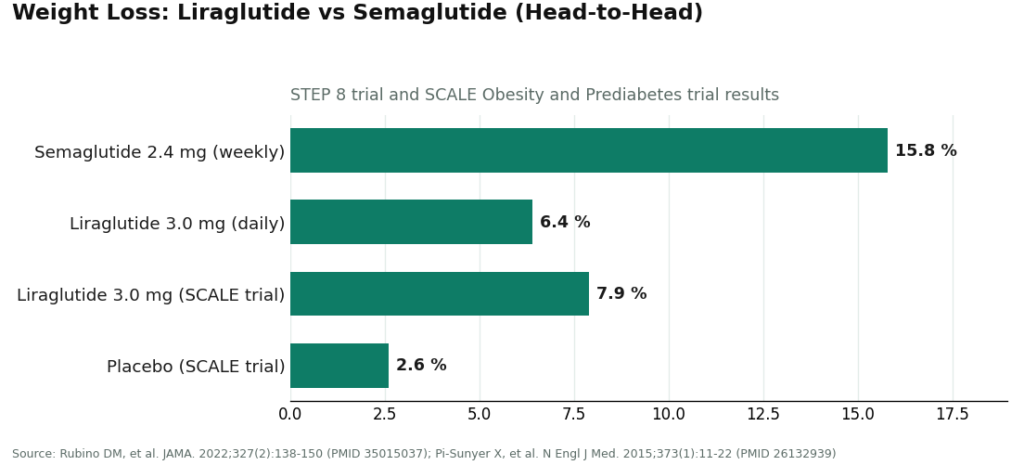
One more number to factor into “cheap,” since it changes what you’re even buying: in that STEP 8 head-to-head trial, semaglutide beat liraglutide on weight loss by a wide margin, and in liraglutide’s own pivotal trial the drug beat placebo but the effect size was more modest. Worth knowing before you commit a monthly budget to one molecule over the other.
Quick answers
What’s the cheapest legitimate liraglutide, actually? The lowest fair price attached to a licensed clinician and a licensed pharmacy. That’s roughly $199 to $449 a month for a supervised program. Aim for the low end of that range. Skip the cheaper-looking gray-market powder entirely; it’s not a price, it’s a gamble on purity and an unmanaged dose.
Should you even be buying liraglutide specifically? Maybe not, and that’s a cost question too. Head-to-head, semaglutide 2.4 mg produced about 15.8% mean weight loss versus about 6.4% for liraglutide [5]. If you’re paying for outcomes, ask a real clinician whether a different molecule gets you more for the money.
Why does supervised cost more than powder? You’re not paying for the molecule. You’re paying for the clinician who evaluates you, the licensed pharmacy, the managed dose climb, and the follow-up. Cut those and you’re alone with an injectable that has real contraindications and a titration curve that decides whether you can even stay on it.
Does FDA approval affect the price question? It makes the legitimate lane clear, which is what protects you from the gray-market trap in the first place. Saxenda and Victoza are FDA-approved [1][2]. Compounded liraglutide is not the same product as the approved pen, and a straight-shooting provider will say so.
Bottom line
Run every option through the four checks before you look at price. FormBlends passes with the cleanest number-to-accountability ratio, HealthRX.com is right behind it on the same grounds, and the rest of the field is legitimate but less tightly built around this specific drug and this specific goal. Skip the powder outright; it fails check three and four before you even get to price. Pay for the supervision, not just the vial.
Verified citations
- Saxenda (liraglutide) injection, prescribing information, DailyMed (U.S. National Library of Medicine). Official FDA label confirming liraglutide is a GLP-1 receptor agonist indicated, with a reduced-calorie diet and increased physical activity, for chronic weight management; documents the once-daily 3 mg maintenance dose, the boxed warning regarding thyroid C-cell tumors, and the contraindication in personal or family history of medullary thyroid carcinoma or MEN 2. https://dailymed.nlm.nih.gov/dailymed/drugInfo.cfm?setid=3946d389-0926-4f77-a708-0acb8153b143
- U.S. Food and Drug Administration. “FDA approves weight management drug for patients aged 12 and older.” FDA communication on Saxenda (liraglutide), confirming approval for chronic weight management, originally in adults and subsequently expanded to include patients 12 years and older with obesity. https://www.fda.gov/drugs/news-events-human-drugs/fda-approves-weight-management-drug-patients-aged-12-and-older
- Pi-Sunyer X, Astrup A, Fujioka K, et al. “A Randomized, Controlled Trial of 3.0 mg of Liraglutide in Weight Management.” N Engl J Med. 2015;373(1):11-22. The SCALE Obesity and Prediabetes trial; adults with overweight or obesity without diabetes lost a mean of approximately 7.9% of body weight on liraglutide 3.0 mg at 56 weeks versus approximately 2.6% on placebo. PMID 26132939.
- Marso SP, Daniels GH, Brown-Frandsen K, et al. “Liraglutide and Cardiovascular Outcomes in Type 2 Diabetes.” N Engl J Med. 2016;375(4):311-322. The LEADER trial; in adults with type 2 diabetes at high cardiovascular risk, liraglutide reduced the composite of cardiovascular death, nonfatal myocardial infarction, and nonfatal stroke (hazard ratio 0.87; 95% CI 0.78 to 0.97). PMID 27295427.
- Rubino DM, Greenway FL, Khalid U, et al. “Effect of Weekly Subcutaneous Semaglutide vs Daily Liraglutide on Body Weight in Adults With Overweight or Obesity Without Diabetes: The STEP 8 Randomized Clinical Trial.” JAMA. 2022;327(2):138-150. Head-to-head randomized trial; once-weekly semaglutide 2.4 mg produced approximately 15.8% mean weight loss versus approximately 6.4% for once-daily liraglutide 3.0 mg. PMID 35015037.
What is liraglutide and what is it used for?
Liraglutide is a prescription drug that mimics a gut hormone called GLP-1 to control blood sugar and appetite. FDA-approved under two brand names: Victoza for type 2 diabetes, Saxenda for chronic weight management. Some doctors use it off-label for other metabolic conditions. It’s a self-administered subcutaneous injection, once daily, in the abdomen, thigh, or upper arm.
Is liraglutide the same as Ozempic or semaglutide?
No. Same drug class (GLP-1 receptor agonist), different molecules, different schedules, different approved uses. Ozempic and Wegovy are semaglutide, injected weekly. Liraglutide is injected daily. Trial data shows semaglutide producing more average weight loss, though your individual result may differ.
Is liraglutide actually approved for weight loss, or is that off-label?
Saxenda (liraglutide, 3 mg daily) has a specific FDA approval for chronic weight management in adults with a BMI of 30+, or 27+ with a weight-related condition. Victoza, the lower-dose version, is approved only for diabetes, so using it for weight loss would be off-label. This matters for insurance, so confirm which indication your prescription is written under.
Where do you actually buy liraglutide without overpaying or getting scammed?
An FDA-approved brand through a licensed U.S. pharmacy, or, if cost is the barrier, a physician-supervised compounding pharmacy like FormBlends that operates under real medical oversight and can tell you exactly what’s in the vial. Never buy anything labeled “research use only” or sold without requiring a prescription. Those products have no quality control and no accountability if something goes wrong.